Tanshishan Culture
Introduction
Tanshishan Culture refers to the earliest named archaeological culture discovered on China's southeast coast. It is recognized as the first archaeological culture in Fujian province and serves as a significant source of marine culture in Fujian and Taiwan during the pre-Qin period, prior to 221 BC. In October 2021, commemorating the 100th anniversary of modern Chinese archaeology, the Tanshishan site was included in China's Top 100 Archaeological Discoveries of the Century, marking it as the only site selected from Fujian province.
Historical Significance
The excavation and research of Tanshishan cultural relics have played a pivotal role in understanding prehistoric culture in Fujian. It has extended the known history of Fujian civilization from 3,000 years to approximately 5,000 years, substantiating Su Bingqi's theory regarding the pluralistic origin of Chinese civilization. The site encompasses cultural relics spanning from the Neolithic to the Bronze Age and was initially discovered in 1954. It covers an area exceeding 30,000 square meters with well-preserved cultural artifacts.
Archaeological Discoveries
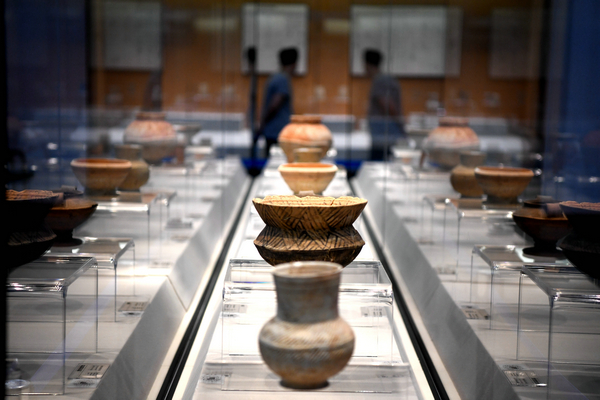
The Tanshishan archaeological site has revealed nearly 100 burial sites along with various cultural relics, such as pottery kilns, trenches, ash pits, and numerous valuable artifacts. The Neolithic culture evidenced by these artifacts is distinctive to the region, leading to the identification of the culture as Tanshishan Culture. This culture primarily thrived in the lower reaches of the Minjiang River and Fujian's eastern coastal areas. The inhabitants engaged in activities such as pottery-making, weaving, farming, hunting, and marine exploration, contributing to the roots of Austronesian cultures.
Cultural Artifacts and Marine Culture
The site is integral in showcasing the beginnings of Fujian's marine culture. During the Neolithic era, humans transitioned from mere natural parasites to active transformers, and the ancestors of Tanshishan culture embodied this transformation through maritime cultural creations. Artifacts like shellware and pottery kettles possess distinctive marine culture characteristics, representing Fujian's earliest systematic expressions of marine life.
Shellware, a notable marine cultural artifact from Tanshishan Culture, was crafted using oyster shells for various production tools. The techniques for creating stone tools, such as drilling and cutting, were adapted for shellware production. Pottery kettles, frequently found at the site, illustrate the dietary preferences and hierarchical social structures of the Tanshishan people, who favored cooking seafood and river food separately.
Contribution to the Theory of Pluralistic Origin
In 1963, the archaeological community classified Fujian's Neolithic cultural remains, represented by geometric hard pottery from the Tanshishan site, as Tanshishan Culture. Various excavations, such as those in 1996, have delineated the site's chronological importance through stratigraphy and archaeological dating. The site reflects the cultural phases equivalent to northern China's Yangshao, Longshan, and Shang-Zhou periods, substantiating Su Bingqi's theory on the pluralistic origin of Chinese civilization.
Further Archaeological Efforts and Cultural Promotion
The Tanshishan site remains crucial for research on ancient Fujian marine culture and prehistoric navigation technology. Efforts are being made to enhance archaeological studies at the site and promote Tanshishan Culture. Multidisciplinary research and digital technology are utilized to protect and display the site, while studies on prehistoric sites in the Minjiang River basin seek to uncover more insights into the cultural distribution.
The Museum of Tanshishan Historical Relics aims to promote the creative transformation and innovative development of traditional Chinese culture. It focuses on Tanshishan Culture, delving into its origins and influence, linking Fujian's prehistoric cultural sites with broader archaeological contexts. These endeavors serve to uphold the cultural heritage of Tanshishan and explore its multiple values, contributing to the understanding of Chinese civilization and maritime culture.








